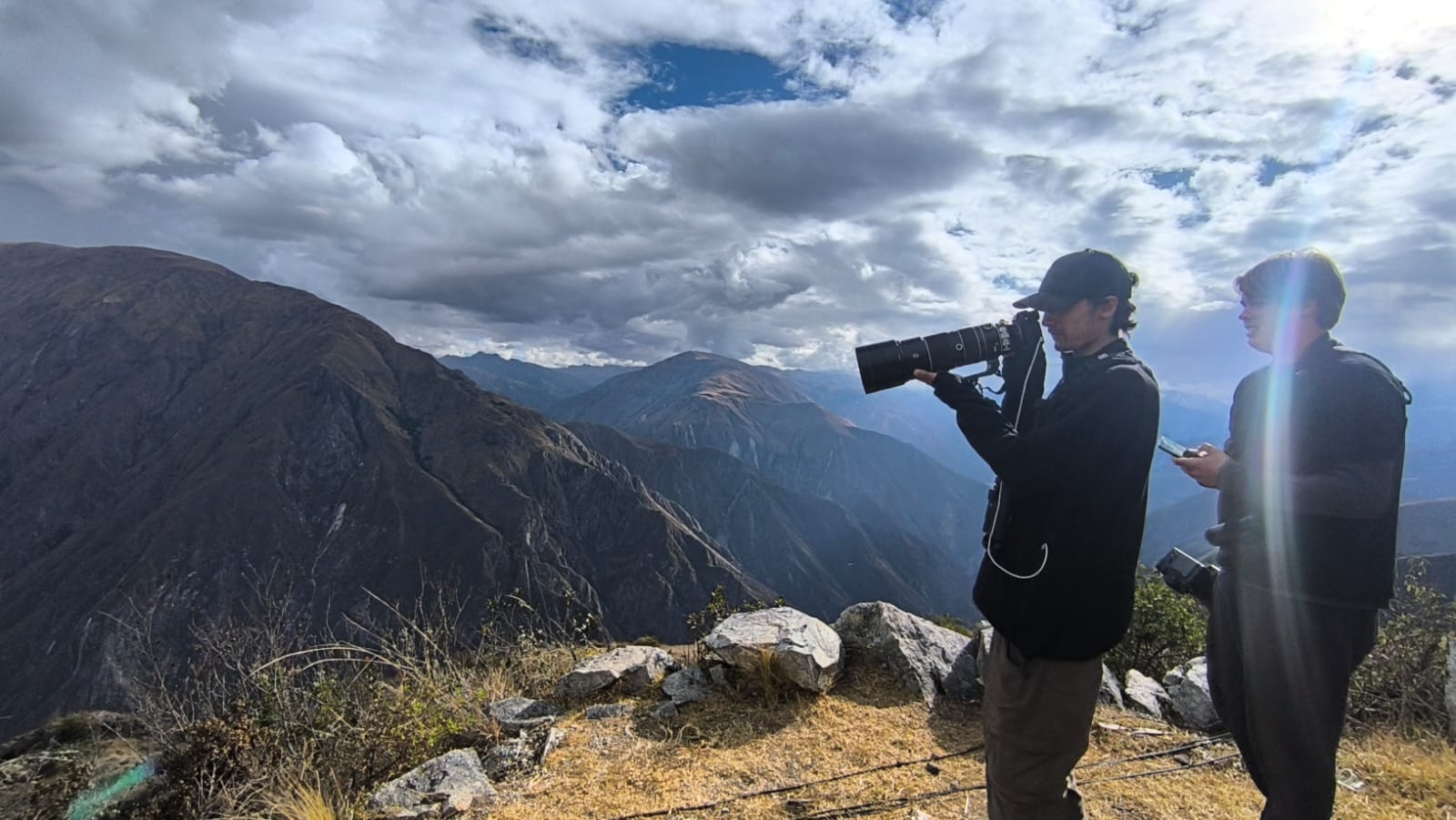
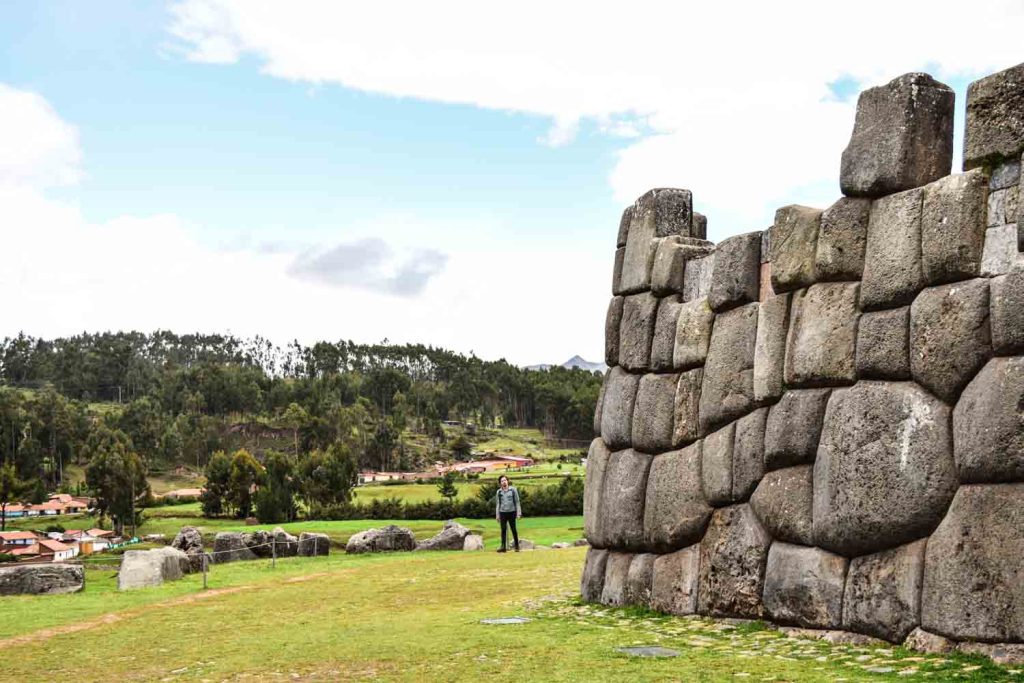
The hummingbirds of Peru are among the most spectacular wildlife subjects on Earth. With over 120 species recorded across its territory, Peru holds one of the highest concentrations of hummingbird diversity on the planet — and nowhere is this more extraordinary than in Manu National Park, a UNESCO World Heritage Site that stretches from the high Andes down to the heart of the Amazonian lowlands.
For wildlife photographers and birders willing to venture into this remote corner of South America, the rewards are unparalleled: endemic species found nowhere else, pristine habitats largely undisturbed by human activity, and access to multiple ecological zones within a single expedition. This guide covers the best specific locations within Manu to photograph hummingbirds of Peru, along with the key species you can expect to encounter at each site.
Why Cusco and Manu National Park are the Best Places to Photograph Hummingbirds of Peru
Manu encompasses approximately 1.7 million hectares and an altitudinal range from 200 to 4,200 meters above sea level. This dramatic gradient means you can photograph cloud forest specialists, Andean mountaineers, and true Amazonian species all within a single journey — an opportunity found in very few places in the world.
The park’s strict protection has kept its ecosystems intact for decades. Bird behavior here is largely undisturbed, making it far easier to photograph hummingbirds of Peru in natural conditions compared to degraded habitats elsewhere. Several sites within Manu have also developed feeding gardens and maintained trails specifically suited to observation and photography.
A key reason Manu stands apart from other destinations for hummingbirds of Peru is its overlap zones. At mid-elevations, highland and lowland species intermix, creating exceptional diversity at single locations. In practical terms, a photographer stationed at a 1,500m lodge may encounter both Andean coronets and true Amazonian hermits within the same morning.
- Why Cusco and Manu National Park are the Best Places to Photograph Hummingbirds of Peru
- Where to watch Hummingbirds of Peru:
- Ensifera Garden
- Sacred Garden (Jardín Sagrado) — High-Altitude Hummingbirds of Peru
- Wayquecha Biological Station — Cloud Forest Research Hub
- Magic Birds — Cloud Forest Diversity Hotspot
- Pico de Oz — Lowland Amazonian Hummingbirds of Peru
- Inkamazonia — Hidden Gem for Hummingbirds of Peru
- Best Time to Visit for Photographing Hummingbirds of Peru
- Planning Your Expedition
Where to watch Hummingbirds of Peru:
Ensifera Garden
Elevation: ~2,800 m | Zone: High Andean / Cusco Region
Named for its star attraction, Ensifera Garden is a private botanical garden near Cusco specifically designed to attract the most spectacular hummingbirds of Peru found in the Sacred Valley of The Incas. The site’s curated plantings of Passiflora, Agave, and Datura create an irresistible nectar corridor for high-elevation specialists, most notably the legendary Sword-billed Hummingbird. The garden’s accessible infrastructure and consistent bird presence make it an excellent first stop on any expedition targeting hummingbirds of Peru in the Cusco region, particularly for visitors who want to photograph endemic Andean species before descending into the cloud forest and lowlands of Manu.
Key Species
Sword-billed Hummingbird (Ensifera ensifera)
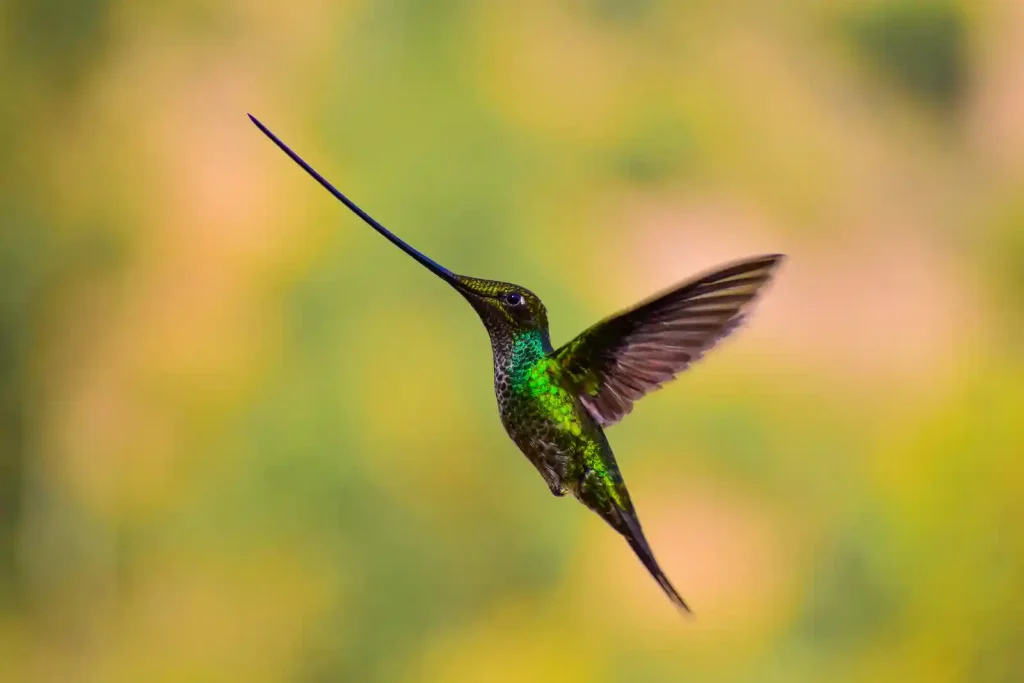
The Sword-billed Hummingbird holds an extraordinary distinction: it is the only bird in the world whose bill is longer than its body, reaching 10–12 cm. This remarkable adaptation evolved exclusively to access the deep nectaries of Passiflora (passionflowers) and Datura flowers, which no other hummingbird can reach. Because of its outsized bill, this species must preen using its feet rather than its bill, a behavior rarely seen in other hummingbirds of Peru. Males are metallic green above with a rufous-buff belly; females are similar but with a spotted white throat. Ensifera Garden is one of the most reliable sites in the Cusco region to observe this iconic Andean species.
White-tufted Sunbeam (Aglaeactis castelnaudii)
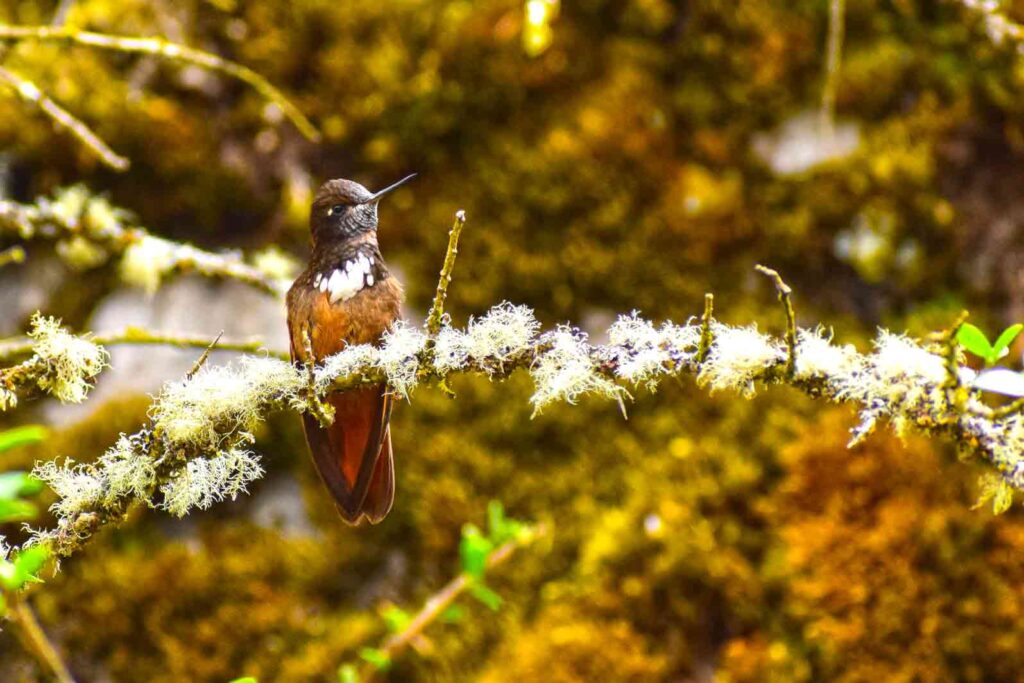
An endemic Peruvian species restricted to high Andean slopes between 3,500–4,800 m, the White-tufted Sunbeam is one of the most distinctive hummingbirds of Peru found at altitude. Its plumage is largely dark brown with a brilliant white chest tuft and a shimmering purple-bronze rump patch that flashes in direct sunlight. Unlike more aggressive territorial species, this sunbeam is a trap-liner, moving methodically between scattered flower clusters of Chuquiragua and Puya. Its predictable circuits and tolerance of close approach make it an excellent photographic subject at Ensifera Garden.
Green-and-white Hummingbird (Elliotomyia viridicauda)
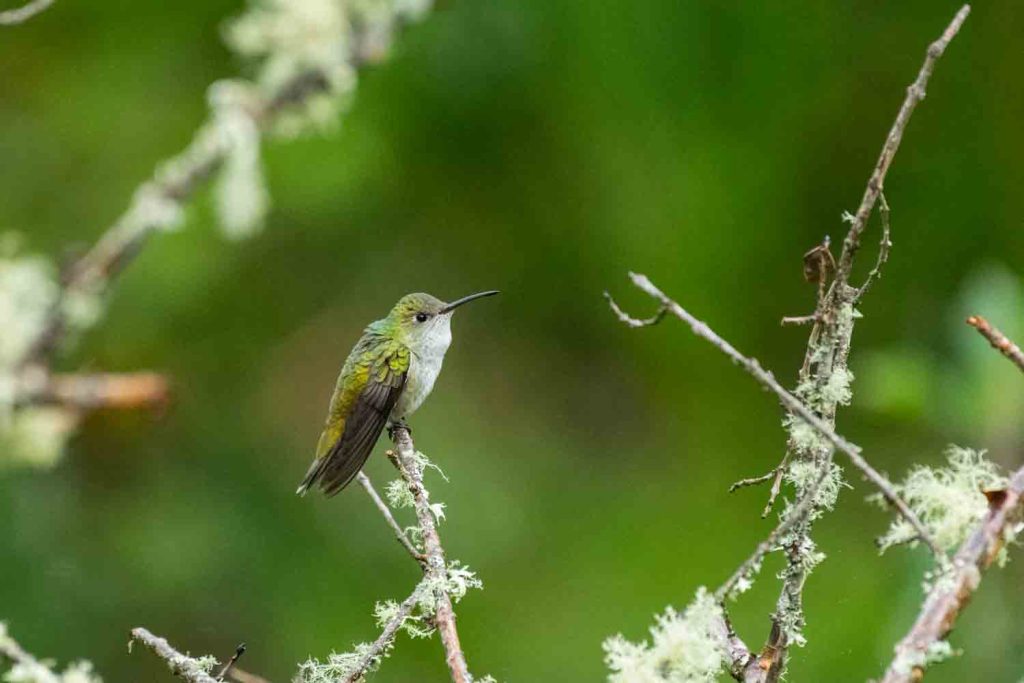
One of Peru’s most sought-after endemics, the Green-and-white Hummingbird has an extremely restricted range confined to a narrow strip of western Andean slopes in the departments of Lima and Ica, between 1,500–3,000 m. Its clean field marks — metallic green upperparts and tail, contrasting with pure white underparts — make it one of the more visually striking hummingbirds of Peru in its size class. This species shows a strong preference for arid and semi-arid habitats with scattered flowering shrubs, particularly Salvia and Nicotiana species. Ensifera Garden provides a reliable opportunity to observe and photograph this range-restricted species without venturing deep into its remote strongholds.
Sacred Garden (Jardín Sagrado) — High-Altitude Hummingbirds of Peru
Elevation: ~2,900 m | Zone: High Andean / Sacred Valley
Sacred Garden is one of the most accessible sites for photographing high-altitude hummingbirds of Peru. Located in the Sacred Valley, it offers reliable encounters with species that are otherwise extremely difficult to observe in the wild.
Key Species
Bearded Mountaineer (Oreonympha nobilis)
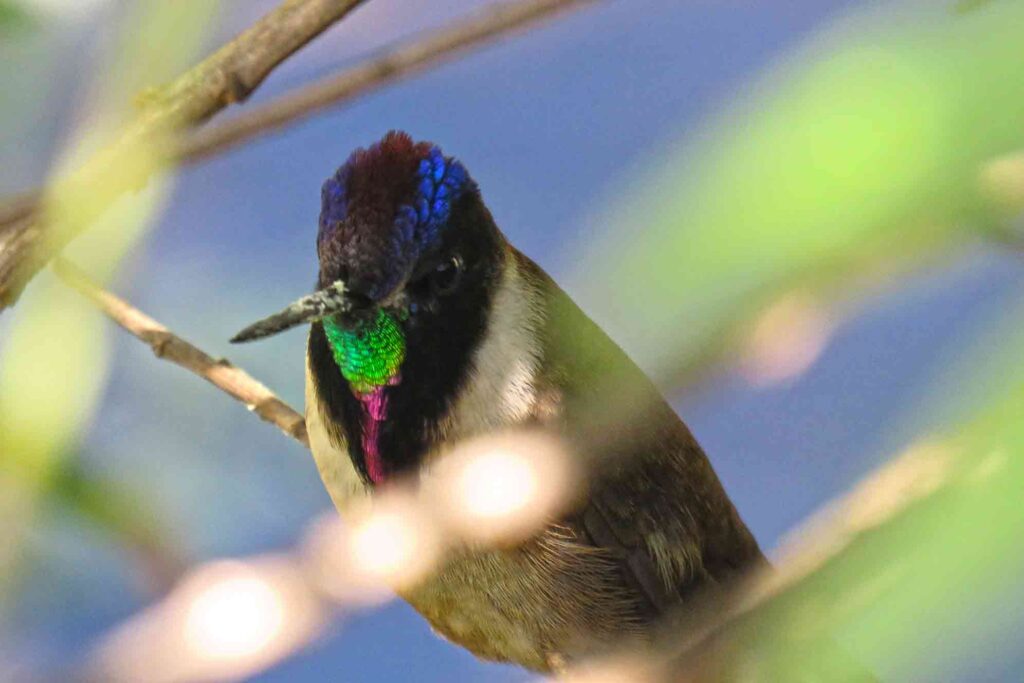
This is the flagship species of Sacred Garden and one of the most sought-after hummingbirds of Peru. It belongs to a monotypic genus — meaning there is no other species in the world like it — and is strictly endemic to Peru. Males are unmistakable: a deeply forked tail, metallic green dorsal plumage, and an elongated white gorget (the “beard”) that gives the species its name. Bearded Mountaineers are trap-liners, following a circuit of Agave, Puya, and Salvia flowers, which makes their movements relatively predictable for photographers.
Giant Hummingbird (Patagona gigas)
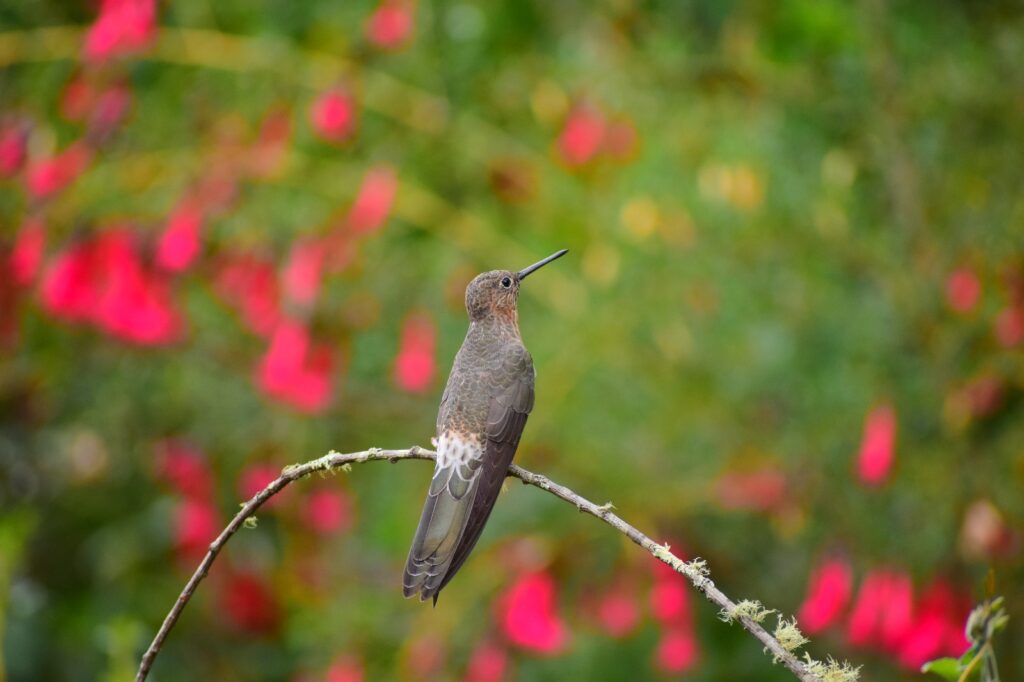
The largest hummingbird in the world, measuring 21–23 cm. Its wingbeat is noticeably slower than other hummingbirds of Peru — almost falcon-like in its deliberate strokes — which paradoxically makes flight shots easier to capture than with smaller, faster species.
Sparkling Violetear (Colibri coruscans)
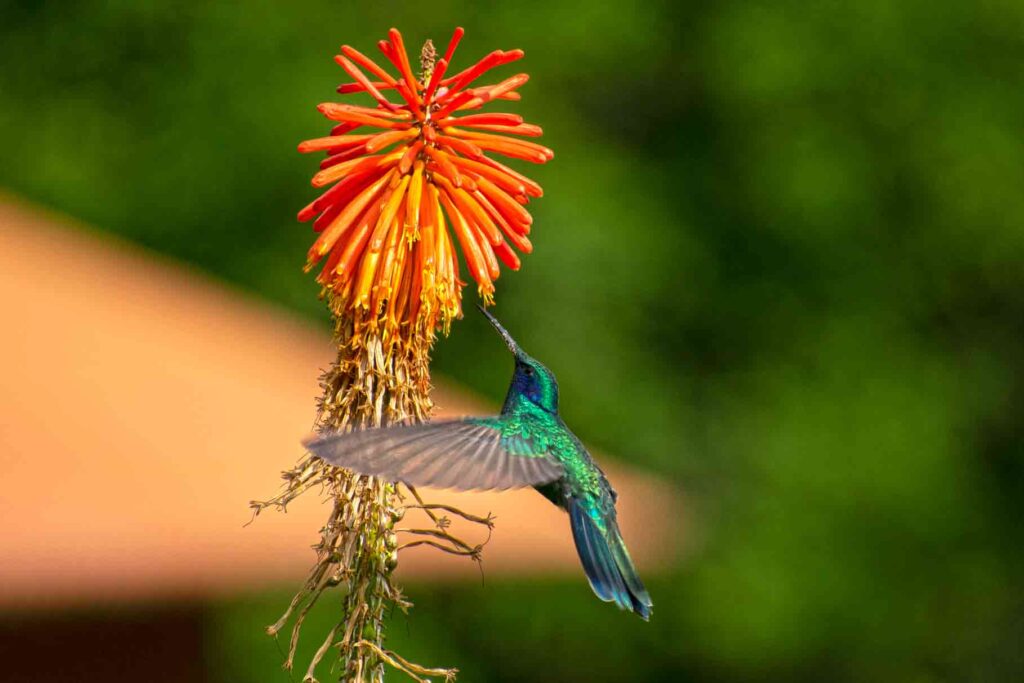
A common but beautiful Andean species with vivid violet auricular patches and iridescent green plumage. Dominant at feeding sites, it frequently displaces smaller hummingbirds of Peru and provides dramatic territorial interaction shots.
Shining Sunbeam (Aglaeactis cupripennis)
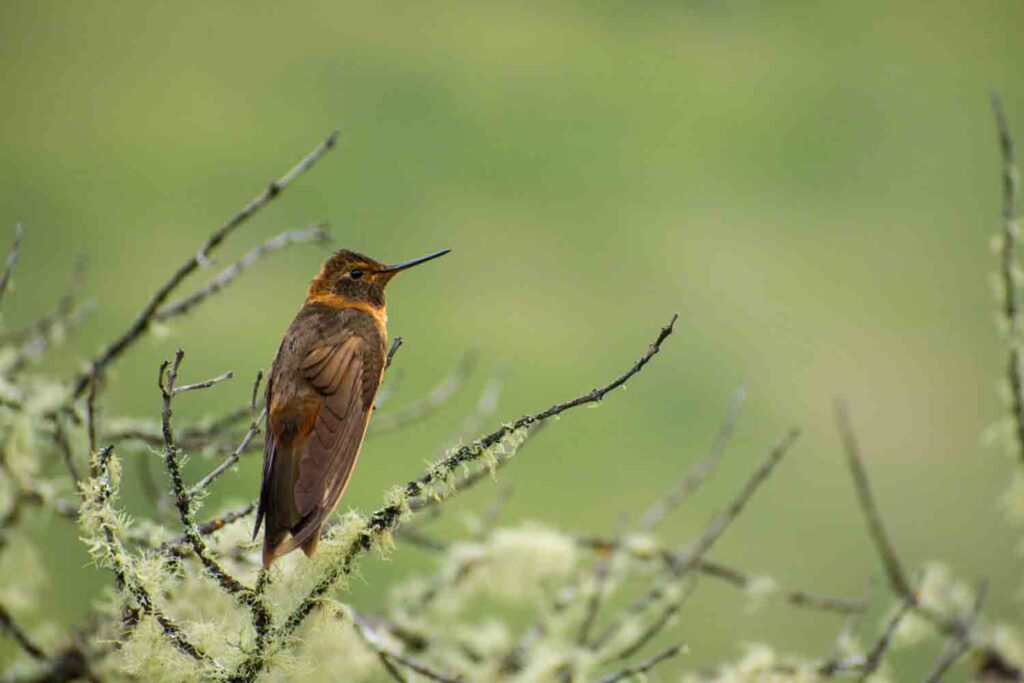
Occasionally present at Sacred Garden, identifiable by its diagnostic copper-bronze wing patches. A high-altitude specialist and one of the more distinctive hummingbirds of Peru found at this elevation.
Wayquecha Biological Station — Cloud Forest Research Hub
Elevation: ~2,950 m | Zone: Eastern Andean Cloud Forest
Wayquecha sits on the eastern slope of the Andes and is both a functioning research station and one of the most productive birding locations in all of Manu. Its extensive trail system leads into pristine cloud forest, making it an exceptional base for photographing cloud forest hummingbirds of Peru.
Key Species
Andean Hillstar (Oreotrochilus estella)
Among the hardiest hummingbirds of Peru, the Andean Hillstar thrives at elevations up to 5,000 m — higher than almost any other hummingbird in the world. It survives frigid Andean nights by entering torpor, dramatically reducing its body temperature to conserve energy. Males display a vivid iridescent purple-violet gorget that appears black in shadow and electric violet in direct light, set against white underparts and olive-green upperparts. Females are plainer, identified by their spotted throat and pale underparts. At Wayquecha, Andean Hillstars are regularly observed at the upper trail edges foraging on puna grasses and Asteraceae shrubs — one of the station’s most striking highland species.
Rufous-capped Thornbill (Chalcostigma ruficeps)
A compact, short-billed cloud forest specialist, the Rufous-capped Thornbill is one of the more distinctive hummingbirds of Peru found at Wayquecha’s elevation. Its diagnostic rufous crown contrasts sharply with its iridescent green gorget — a small but brilliant patch visible when the bird catches direct light. The body is largely olive-brown, with a slightly forked dark tail. This species is a generalist forager at forest edges and in shrubby clearings, moving through low vegetation with quick, darting flights between flower clusters of Ericaceae and Gesneriaceae plants. Though not as conspicuous as some of its fellow hummingbirds of Peru at Wayquecha, patient observers positioned at flowering shrubs along the station’s trails will encounter this species regularly throughout the morning.
White-bellied Woodstar (Chaetocercus mulsant)
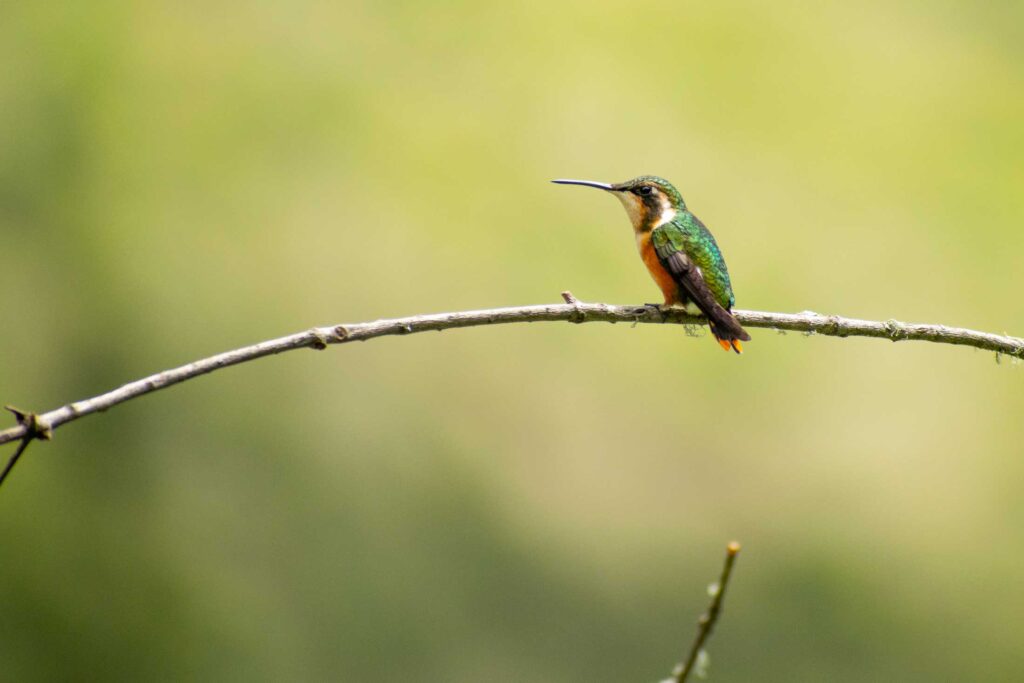
One of the smallest hummingbirds of Peru encountered at Wayquecha, the White-bellied Woodstar measures just 6–7 cm and weighs barely 3 grams. Despite its diminutive size, the male is strikingly patterned: a glittering rose-pink to violet gorget, a white collar band across the chest, and white underparts contrast with the metallic green upperparts. The species’ tiny size and fast wingbeats — producing a characteristic buzzing sound in flight — can make it easy to overlook among the more conspicuous species at the feeders. Females are plain green above with buffy-white underparts and a faint streaked throat. The White-bellied Woodstar favors forest edges and gardens, and is regularly seen at Wayquecha’s flowering hedgerows and station feeders, especially during the early morning hours.
Peruvian Piedtail (Phlogophilus harteri) Among the rarest hummingbirds of Peru, this endemic species is restricted to a narrow elevational band between 2,400–3,100 m in southeastern Peru. It is currently classified as Near Threatened by the IUCN, with population estimates of fewer than 10,000 mature individuals. Field marks include distinctive white tail tips, green upperparts with a coppery-bronze iridescence, and grayish-white underparts. Wayquecha is one of the most reliable sites in the world to see and photograph this species.
The Piedtail favors forest understory and edge habitats, foraging primarily on Ericaceae flowers and occupying a niche that avoids direct competition with more aggressive species. Individuals tolerate closer approach than most other hummingbirds of Peru, making it possible to photograph at relatively short distances.
Magic Birds — Cloud Forest Diversity Hotspot
Elevation: ~2,100 m | Zone: Mid-elevation Cloud Forest
Magic Birds is arguably the single most productive location for photographing hummingbirds of Peru within the Manu corridor. The site maintains dedicated feeding stations and planted gardens designed to attract hummingbirds, regularly drawing 20 or more species. The combination of managed feeders and adjacent natural habitat makes this an exceptional spot for both beginners and advanced photographers.
Key Species
Long-tailed Sylph (Aglaiocercus kingii)
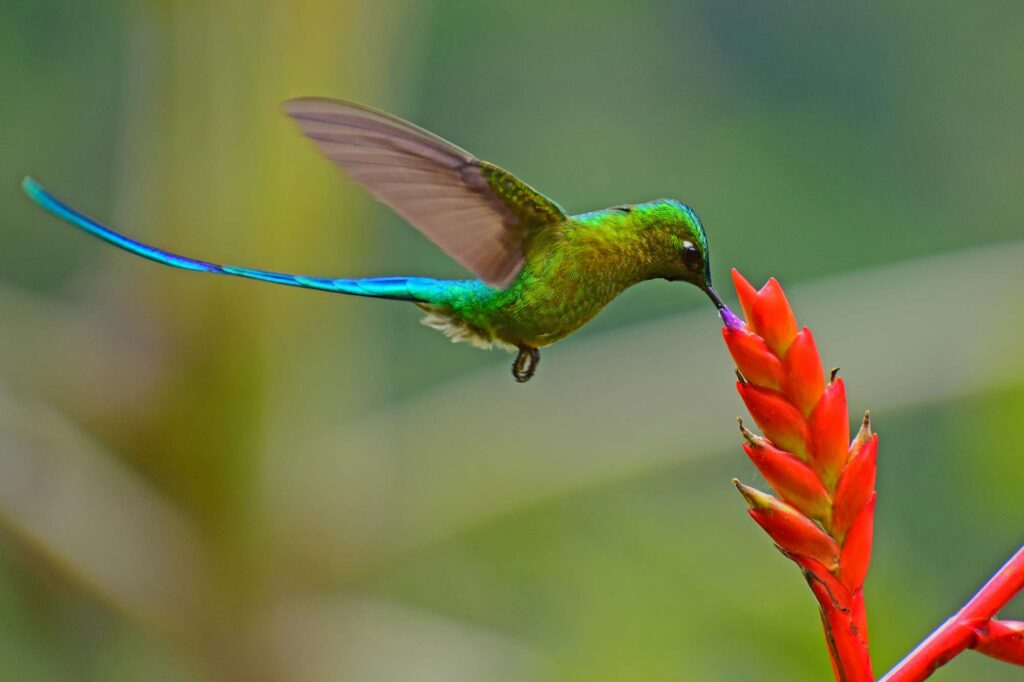
The male Long-tailed Sylph is one of the most visually dramatic hummingbirds of Peru. His tail streamers — a brilliant blue-green that shifts to violet depending on the angle of light — reach 13–16 cm, nearly twice the length of his body. Females are considerably plainer, with green upperparts, cinnamon underparts, and short, white-tipped tails.
Unlike territorial species, Long-tailed Sylphs are trap-liners, visiting flowers along predictable circuits through the forest. This makes it possible to position yourself at a known flower patch and wait for the male’s return rather than trying to track a moving bird.
Booted Racket-tail (Ocreatus underwoodii)
One of the most recognizable hummingbirds of Peru, the Booted Racket-tail is named for two distinct features: the fluffy white “boots” of leg feathers and the dramatically elongated outer tail feathers tipped with expanded, paddle-shaped rackets. The subspecies present in Manu (O. u. peruanus) has buff-colored boots and slightly smaller rackets than northern populations.
This species is notably aggressive. Photographers can expect to witness aerial confrontations, high-speed chases, and bill-fencing — all excellent behavioral subjects.
Amethyst-throated Sunangel (Heliangelus amethysticollis)
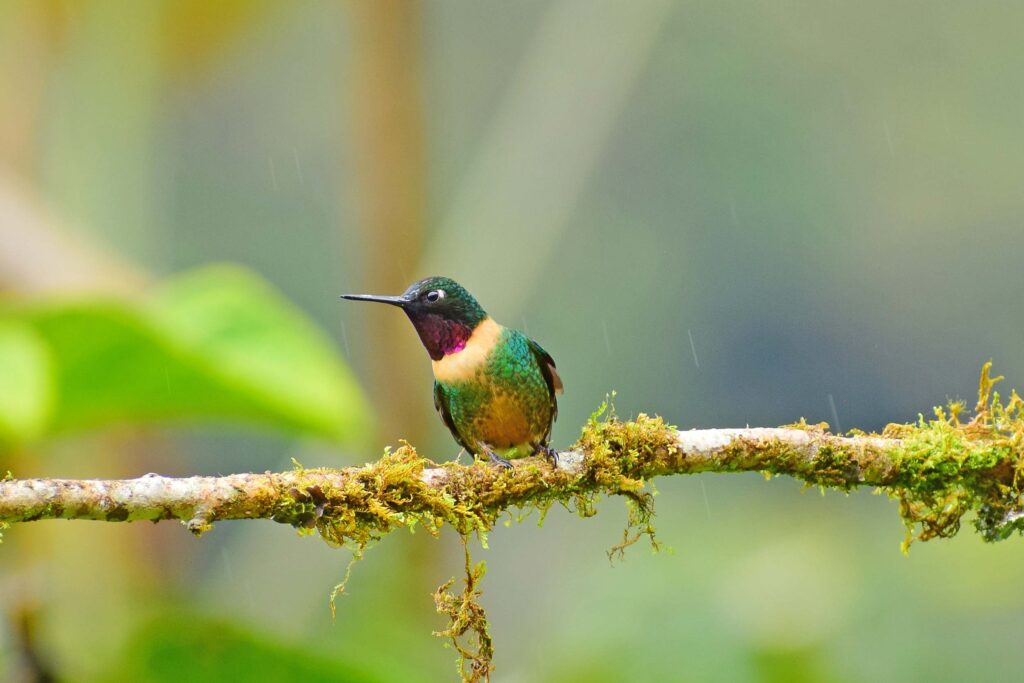
One of the most dazzling hummingbirds of Peru at Magic Birds, the Amethyst-throated Sunangel is named for the male’s brilliant amethyst-purple gorget, which glows intensely when illuminated by direct sunlight. The rest of the plumage is rich metallic green on the upperparts and dark greenish below, with a white postocular spot providing a subtle but useful field mark. Females lack the gorget and are pale buff-white below with faint spotting. This species occupies a distinct niche within the Magic Birds hummingbird community: it is moderately aggressive, capable of defending individual flowers against smaller species, but it regularly yields to the more dominant Booted Racket-tail and Long-tailed Sylph. The Amethyst-throated Sunangel is particularly attracted to the tubular flowers of Salvia and Fuchsia planted in the gardens, making the feeders and flower beds the most reliable spots for close encounters.
Pico de Oz — Lowland Amazonian Hummingbirds of Peru
Elevation: 500 m | Zone: Lowland Transition / Rio Alto Madre de Dios
Descending toward the Amazonian lowlands, Pico de Oz Lodge sits at the ecological transition where true Amazonian hummingbirds of Peru begin to replace Andean species. The site’s position along the Rio Alto Madre de Dios provides exceptional biodiversity, and the mix of open areas, second growth, and primary forest edges supports a markedly different hummingbird community than the cloud forest sites above.
Key Species
Koepcke’s Hermit (Phaethornis koepckeae)
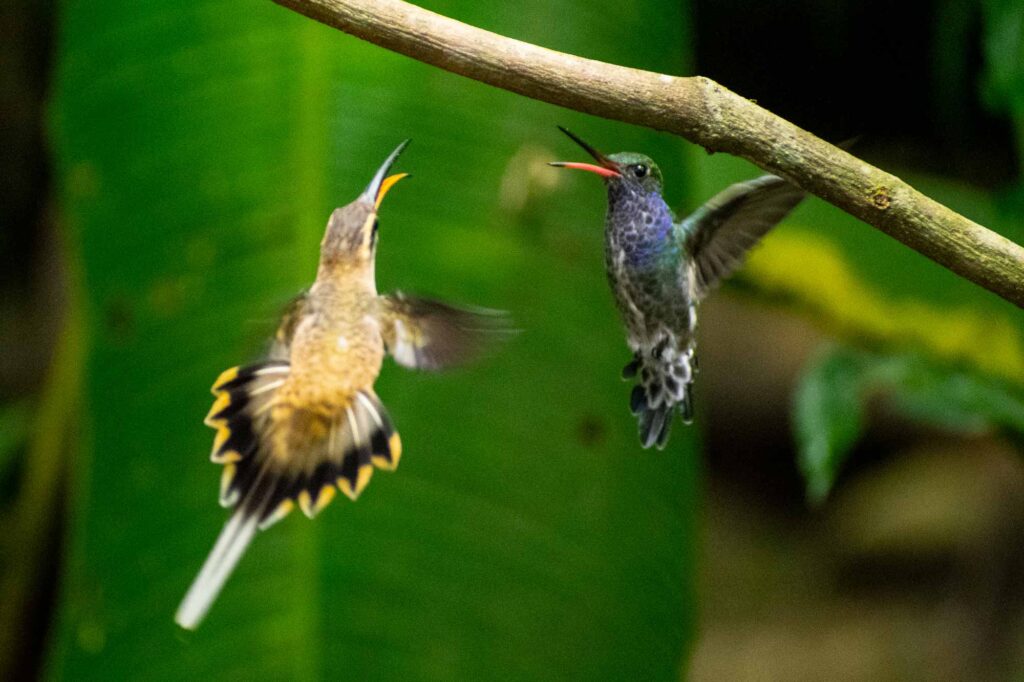
Named in honor of the pioneering ornithologist Maria Koepcke, this endemic Peruvian hermit is among the most geographically restricted hummingbirds of Peru, found only in a narrow corridor of foothill forest along the eastern Andean slopes. It is classified as Vulnerable by the IUCN, making every sighting at Pico de Oz a genuinely significant encounter. Like all hermits, Koepcke’s Hermit belongs to the subfamily Phaethornithinae — a group distinguished by curved bills, long white-tipped tails, and a preference for forest understory. The long, decurved bill is adapted to extracting nectar from Heliconia and Costus inflorescences, with which this species has a specialized co-evolutionary relationship. Males gather at traditional leks in the forest understory, where they sing from low perches to attract females. These leks — often returning to the same locations for years — offer the best opportunity to observe and photograph this rare and sought-after species.
Buff-tailed Sicklebill (Eutoxeres condamini)
The Buff-tailed Sicklebill is one of the most structurally bizarre hummingbirds of Peru: its bill curves so dramatically downward that it appears almost hooked at the tip, a shape mirroring the flower tubes of Heliconia and Centropogon to near perfection. This precise morphological fit means the sicklebill and its preferred flowers are tightly co-evolved, each largely dependent on the other. The plumage is streaked brown and buff below — unusually cryptic for a hummingbird — with metallic green upperparts and a distinctive buff tail tip. Unlike the trap-lining hermits, the Buff-tailed Sicklebill tends to cling to flower inflorescences rather than hovering, a behavior unique among hummingbirds of Peru and instantly diagnostic in the field. At Pico de Oz, this species is encountered most reliably along forest trails where Heliconia grows in dense stands near stream margins.
White-necked Jacobin (Florisuga mellivora)
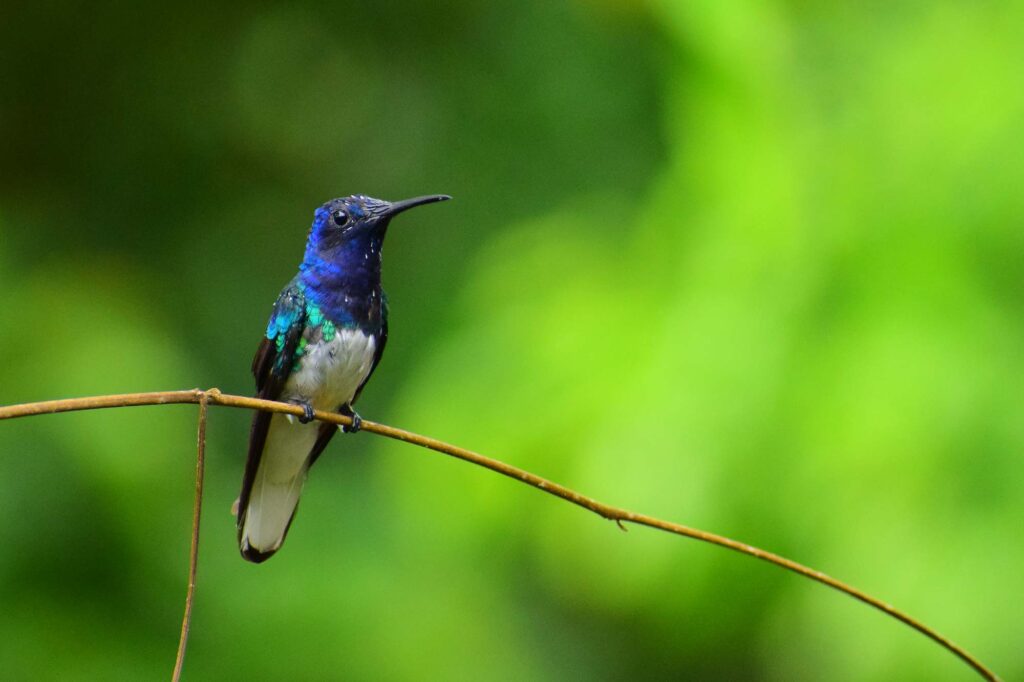
Males are striking: a brilliant blue head, white belly, and clean green back form a bold tricolor pattern. This species also exhibits a fascinating biological quirk — roughly 20% of females display male-like plumage, a polymorphism thought to reduce aggression from dominant males and allow more efficient foraging access. Among hummingbirds of Peru, the White-necked Jacobin is one of the most acrobatic fliers, capable of hovering in winds up to 35 km/h.
Inkamazonia — Hidden Gem for Hummingbirds of Peru
Elevation: 500 m | Zone: Lower Montane Transition
Less visited than the other sites in this guide, Inkamazonia sits at an elevation where highland and lowland species overlap, creating a mixed community unlike any other location along the Manu route. Lower visitor pressure means birds here behave more naturally, and the lodge’s gardens attract an impressive variety of hummingbirds of Peru throughout the day.
Key Species
Rufous-crested Coquette (Lophornis delattrei)
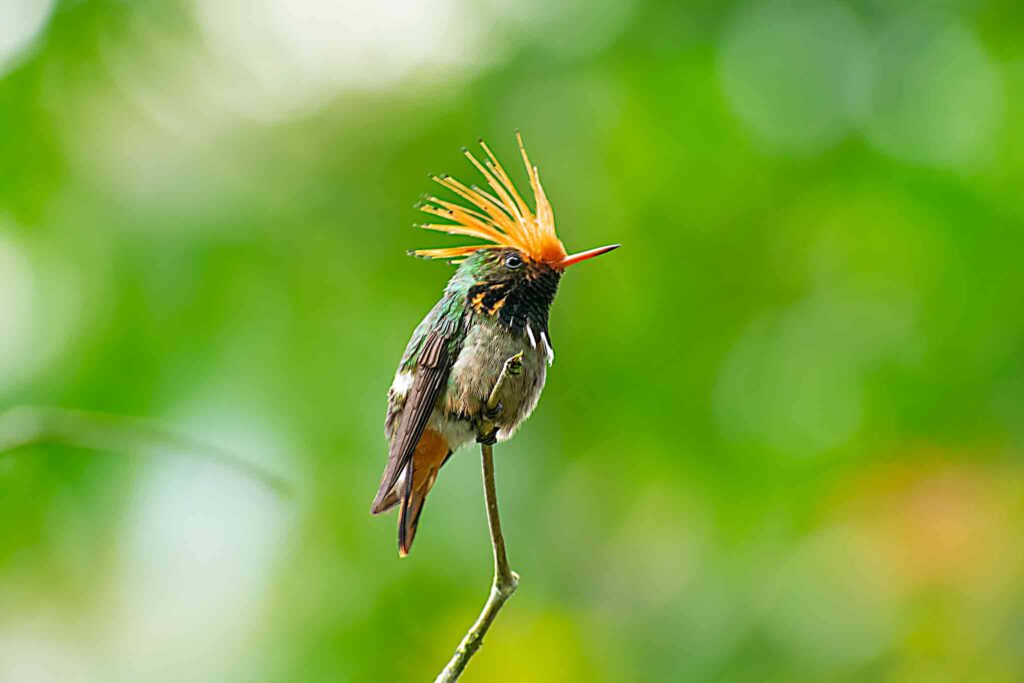
At just 6.5–7 cm and roughly 2.4 grams, this is among the smallest hummingbirds of Peru. Males are ornately decorated with an erectile rufous-orange crest, an iridescent green gorget, and a distinctive buff-white rump band. Females are cryptically patterned in green and white. The tiny size of this species makes it one of the more challenging photographic subjects, but also one of the most rewarding.
Golden-tailed Sapphire (Chrysuronia oenone)
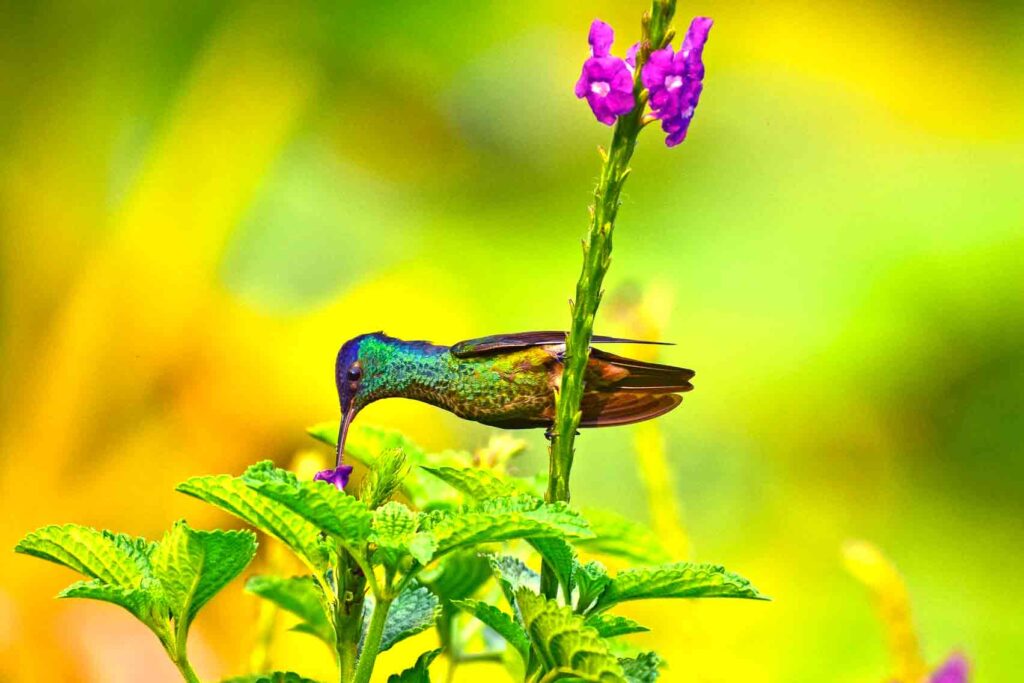
One of the most visually spectacular hummingbirds of Peru in the lowland transition zone. The subspecies present in Manu (C. o. oenone) is characterized by a deep violet-blue crown and throat, a golden-bronze tail that flashes brilliantly in sunlight, and a clean green back. This species serves an important ecological role as a pollinator of canopy-level flowers, accessing resources unavailable to understory specialists.
Many-spotted Hummingbird (Taphrospilus hypostictus)
Identified by heavily spotted white underparts and green upperparts with bronze highlights. This species employs a subordinate foraging strategy among hummingbirds of Peru, feeding quickly at flowers between visits by dominant species rather than defending territory. Careful observation reveals its pattern of rapid opportunistic visits.
Fork-tailed Woodnymph (Thalurania furcata)
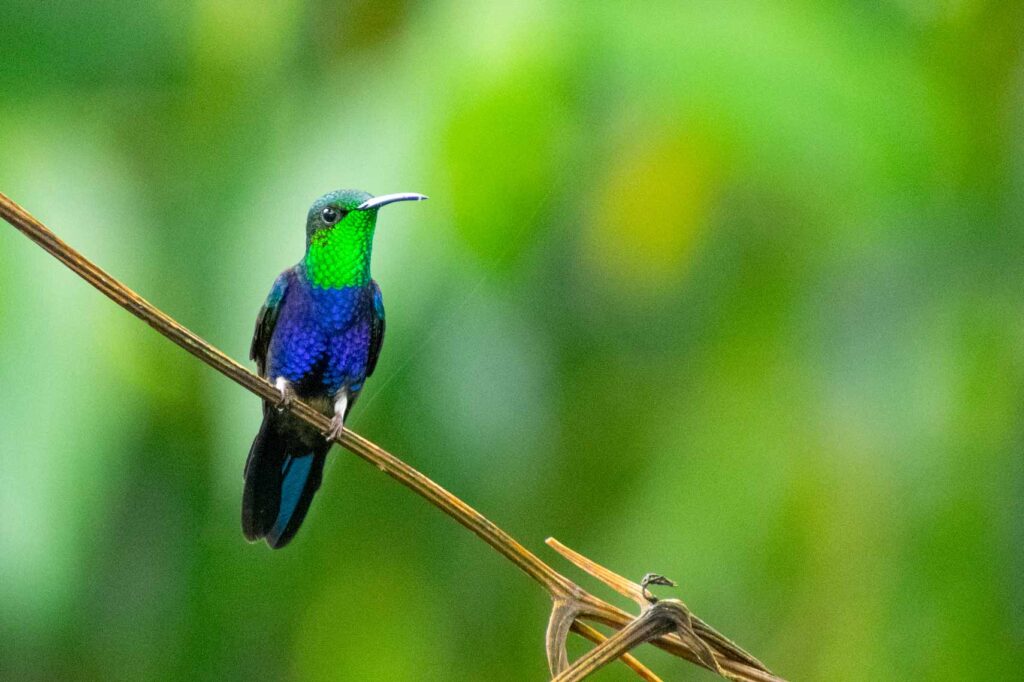
A widespread but beautiful Amazonian species, the Fork-tailed Woodnymph is a common component of lowland hummingbird communities in Peru. Males are vivid blue-green with a deeply forked tail; females are more subdued with a pale gray belly. Often seen at forest edges and along rivers.
Best Time to Visit for Photographing Hummingbirds of Peru
Dry season (May–October) is generally recommended for photography. Trails are more accessible, forest light improves as some trees drop leaves, and bird activity is more predictable. Many hummingbird-pollinated plants also flower during this period, concentrating feeding activity at known sites.
Wet season (November–April) brings peak flowering intensity for many plants and fewer tourists, but rain, mud, and low-light conditions make photography more challenging. For birders focused purely on species totals rather than image quality, the wet season can be highly productive.
For most photographers targeting hummingbirds of Peru in Manu, June through September represents the optimal window — reliable weather, good light, and active birds.
Planning Your Expedition
Gateway: All expeditions to Manu depart from Cusco. Spend at least two days acclimatizing before beginning the descent, as the altitude affects both physical performance and battery life.
Duration: A minimum of 7 days allows coverage of 2–3 elevational zones. For serious photographers aiming to document multiple species across all the sites listed here, 10–14 days is strongly recommended.
Route: The overland route via Paucartambo (8–12 hours) passes through cloud forest and offers excellent birding en route, including multiple stops at different elevations. This is the preferred approach for anyone wanting comprehensive coverage of hummingbirds of Peru across the full altitudinal gradient.
Permits: Some zones within Manu require advance authorization. These should be arranged several weeks before travel through an authorized operator.
For anyone serious about photographing or observing hummingbirds of Peru, Manu National Park offers an experience without parallel. From the endemic Bearded Mountaineer at Sacred Garden to the iridescent Golden-tailed Sapphire at Inkamazonia, from the miniature Rufous-crested Coquette at Magic Birds to the lek-singing hermits of Pico de Oz, each site along the Manu corridor presents a distinct community of species and a distinct set of photographic opportunities.
Peru’s hummingbirds are not just birds — they are some of the most evolutionarily refined creatures on the planet, shaped by millions of years of co-evolution with the flowers of the Andes and Amazon. Witnessing them in the intact ecosystems of Manu, where human pressure remains minimal and natural behavior is on full display, is one of the defining wildlife experiences available anywhere in the world.
Planning a trip to photograph hummingbirds of Peru? Neotropic Peru specializes in customized birding and photography expeditions to Manu National Park. Contact us to design an itinerary tailored to your target species and experience level.